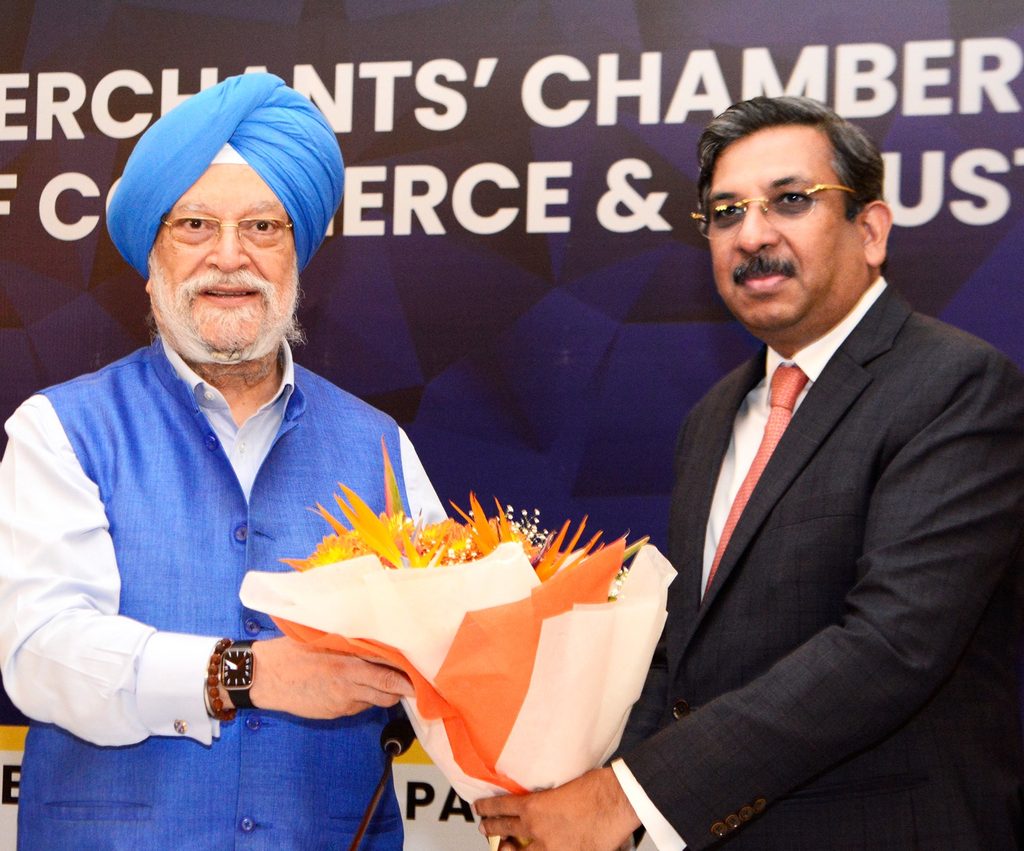
Kolkata, 28 September 2026: India has navigated the complexities of global energy security with considerable resilience amid geopolitical turbulence, Union Minister for Petroleum and Natural Gas Shri Hardeep Singh Puri said at an exclusive session organised by the Merchants’ Chamber of Commerce and Industry (MCCI) at The Park Hotel, Kolkata, on Monday.
The session, titled ‘India’s Energy Security: Navigating Geopolitical Uncertainty’, brought the Minister before members of the business community for an extensive discussion on India’s energy preparedness, global supply disruptions and the challenges arising from geopolitical developments.
Addressing the gathering, Shri Hardeep Singh Puri said, “In every crisis, there is a challenge. Challenge throws up opportunities.” Referring to the impact of geopolitical turbulence on energy security, he observed that the present situation should be viewed as “turbulence, not uncertainty”. According to him, the government’s principal responsibility was to insulate India’s 1.4 billion people from fluctuations in international energy prices.
The Minister noted that global energy prices had risen by more than 70 per cent, while the increase in India remained substantially lower. He attributed this to the Prime Minister’s resolve to ensure availability and affordability of energy. He also pointed out that petrol and diesel prices had been reduced three times through cuts in excise duties.
Shri Puri further stated that oil marketing companies had faced substantial under-recoveries and financial pressures, while emphasising that the government would not allow these companies to collapse. He explained that during periods of elevated crude prices, upstream companies generally benefit whereas downstream companies face greater pressure.
According to the Minister, India had so far navigated the crisis effectively. He highlighted that despite the global disruptions, none of the country’s retail fuel outlets ran dry, demonstrating the resilience of India’s energy supply system.
Discussing global energy vulnerabilities, Shri Puri said that there was no fundamental shortage of crude oil in the world; rather, the principal challenge concerned supply routes. He specifically drew attention to the strategic significance of the Strait of Hormuz, warning that any prolonged closure of the crucial maritime chokepoint could disrupt nearly 40 per cent of global energy supplies.
He said his primary concern was not crude availability but LPG supplies, given that India has approximately 33.5 crore LPG connections, covering virtually the entire population. While LNG is available as an alternative energy source, a substantial section of Indian households continues to depend on LPG.
Speaking about West Bengal, Shri Puri said the state’s economy had declined over the past five decades, but recent developments could enable the state to occupy a more prominent position in India’s economic landscape. “Economic progress of West Bengal is of highest priority of the Centre. That is why the India Energy Week is being held here,” he said.
The Minister also stated that the Centre has earmarked ₹84,000 crore for exploration and production (E&P), underlining the government’s focus on strengthening domestic energy capabilities.
Earlier, Shri Munish Jhajharia, President, MCCI, in his Welcome Address, said that India is currently the world’s third-largest primary energy consumer, while approximately 85 per cent of its crude oil requirement is dependent on imports.
He emphasised that for India’s business community, affordable energy is as important as energy availability, particularly amid an increasingly volatile international energy environment.
Shri Jhajharia further highlighted the strategic importance of the Strait of Hormuz, describing it as one of the world’s most critical energy chokepoints and noting that roughly one-fifth of global oil and LNG flows pass through the route.
He also highlighted India’s strategic petroleum reserves, stating that the country currently has 5.33 million tonnes of strategic petroleum reserve capacity, equivalent to approximately 9.5 days of crude-oil requirement. In addition, India possesses overall crude and petroleum-product storage capacity equivalent to approximately 74 days of cover, including stocks maintained by oil marketing companies.
The MCCI session thus provided an important platform for examining India’s energy resilience, strategic petroleum preparedness, import dependence and the broader implications of geopolitical disruptions for industry and the national economy.
Photo Caption: Munish Jhajharia , President, MCCI presenting a bouquet to Hardeep Singh Puri , Hon’ble Minister of Petroleum & Natural Gas, Government of India at MCCI Exclusive Session on India’s Energy Security: Navigating Geopolitical Uncertainty , 28 September 2026 at Pine Hall , Park Hotel