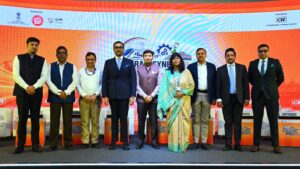
Kolkata, 19 August 2026: Eastern Railway is poised to undertake an ambitious programme of infrastructural augmentation, capacity enhancement and technological modernisation, with an estimated investment of approximately ₹12,000 crore over the next four to five years, Ms Gitika Pandey, General Manager, Eastern Railway, announced at the 2nd edition of Rail Synergy & Bengal MSME Vendor Connect Summit 2026 in Kolkata.
Ms Pandey delineated that the strategic priorities of Eastern Railway encompass augmenting carrying capacity, accelerating multi-tracking initiatives, modernising railway yards and developing sophisticated terminal infrastructure. She underscored that the contemporary railway ecosystem constitutes an indispensable fulcrum for economic expansion, industrial competitiveness and regional connectivity.
“Railways connect markets, people and aspirations,” Ms Pandey observed, emphasising that a resilient and technologically advanced railway network can substantially attenuate logistics expenditure, rationalise supply-chain operations and fortify the competitive positioning of India’s manufacturing sector. She further exhorted Micro, Small and Medium Enterprises (MSMEs) to cultivate innovative products and economically viable technological solutions so as to enlarge their contribution to the national economic architecture.
Speaking on the structural transformation imperative within the industrial ecosystem, Mr Palash Srivastava, Deputy Managing Director, India Infrastructure Finance Company Ltd, advocated the intensification of value-chain financing and a renewed impetus towards an expansive manufacturing renaissance. He identified the persistent “missing middle” within the prevailing industrial-financing ecosystem and stressed the necessity of cluster-centric financing mechanisms and community infrastructure development to construct a more resilient, equitable and inclusive industrial framework.
Mr P K Das, Director, MSME DFO, Kolkata, apprised participants of the MSME Development (Amendment) Bill, 2026, recently passed by Parliament, which seeks to confront the protracted predicament of delayed payments confronting MSMEs. He simultaneously illuminated the principal impediments besetting West Bengal’s MSME ecosystem, particularly with regard to institutional finance, technological access, human-resource skilling and penetration into international export markets.
Highlighting India’s formidable railway footprint, Mr Sudipta Mukherjee, Managing Director, Texmaco Rail & Engineering Ltd, pointed out that India possesses the fourth-largest railway network globally and ranks as the world’s second-largest rail freight carrier. He underscored the exigency of sustained long-term planning, strategic foresight and coherent governmental intervention to further consolidate, modernise and expand the country’s railway infrastructure.
Providing an overview of Kolkata’s rapidly evolving urban transit architecture, Mr Prem Sagar Gupta, General Manager, Metro Railway, Kolkata, stated that approximately 6.5 lakh passengers traverse the Kolkata Metro every day. The metropolitan network presently encompasses 57 operational Metro stations, while a further 31 stations are expected to become operational shortly, substantially reinforcing the city’s mass-transit connectivity and metropolitan mobility matrix.
Articulating a broader strategic vision for Indian Railways, Mr Rahul Khaitan, Co-Chairman, CII West Bengal Railway Task Force & Managing Director, Rahee Infratech Ltd, stated that by 2030, the railway system collectively constructed by India must attain global competitiveness not merely in terms of track length and freight tonnage, but also through operational reliability, accelerated turnaround cycles and the profundity of the industrial ecosystem underpinning railway development.
Mr Vivek Lohia, Chairman, CII West Bengal Railway Task Force & Managing Director, Jupiter Wagons Ltd, underscored West Bengal’s considerable latent potential for industrial expansion. He identified the availability of a skilled workforce, geographical proximity to mineral and mining resources, and the presence of freight corridors as critical structural advantages capable of catalysing further industrialisation across the state.
The summit brought together an extensive constellation of stakeholders representing the railway sector, manufacturing industry, MSMEs, government institutions and allied industrial domains. The deliberations facilitated substantive B2B and B2G engagements, enabling vendors and enterprises to establish meaningful commercial linkages with industry leaders and governmental representatives.
The Rail Synergy & Bengal MSME Vendor Connect Summit 2026 thus emerged as a consequential platform for fostering industrial symbiosis, strengthening vendor ecosystems, catalysing indigenous manufacturing capabilities and synchronising MSME growth with the infrastructural imperatives of India’s rapidly transforming railway sector.