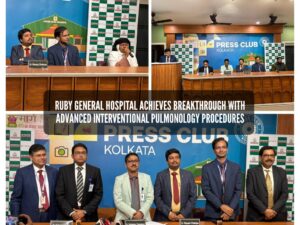
The Department of Pulmonology & Respiratory Medicine at Ruby General Hospital has successfully performed a series of rare and life-saving Emergency Advanced Interventional Pulmonology procedures, reaffirming its position as a leading center for minimally invasive respiratory care in Eastern India.
Advanced Interventional Pulmonology is a rapidly evolving subspecialty that focuses on minimally invasive diagnostic and therapeutic procedures for complex airway, lung, and pleural diseases. These procedures offer effective alternatives to traditional open surgeries and are often performed as outpatient interventions, significantly reducing recovery time and complications.
Over the past month, the hospital’s dedicated Interventional Pulmonology team — comprising Dr. Subhankar Chakraborty, Dr. Deboprasad Das, and Dr. Riksoam Chatterjee — successfully managed two extremely challenging and rare cases that transformed life-threatening situations into instant relief without any surgical incision.
62-Year-Old Woman from Jharkhand Regains Breath After Critical Airway Obstruction
The first case involved a 62-year-old woman from Jharkhand who initially visited the OPD with complaints of progressive respiratory distress, persistent dry cough with streaky hemoptysis, and severe left-sided chest pain for three months. Her condition deteriorated rapidly, and she had to be rushed to the Emergency Department as she was unable to breathe even while waiting.
After detailed clinical and radiological evaluation, videobronchoscopy revealed a bulky tumor completely obstructing the left main bronchus, resulting in total collapse of the left lung. Following detailed discussions with the family and obtaining informed consent, the patient was scheduled for rigid bronchoscopy under general anaesthesia.
The expert pulmonology team meticulously removed the entire tumor, successfully restoring the airway. Immediately after the procedure, the left main bronchus reopened fully, and the collapsed lung re-expanded, providing instant relief to the patient. Doctors noted that prolonged collapse could have resulted in irreversible damage.
Rigid bronchoscopy, a minimally invasive operative procedure, played a crucial role in the intervention. It allows direct visualization and treatment of central airway obstructions such as tumors, foreign bodies, and strictures. The technique is also widely used for tumor debulking, controlling life-threatening hemoptysis, and placing airway stents.
69-Year-Old from Midnapore Successfully Treated for Suspected Malignancy
The second case involved a 69-year-old senior citizen from Midnapore who presented with breathlessness and chest discomfort, along with a history of COPD and heavy smoking. A low-dose CT scan of the thorax revealed a spiculated nodule in the right upper lobe and a pedunculated intrabronchial growth in the left upper lobe. A subsequent FDG Digital PET-CT scan showed significant SUV uptake, strongly indicating malignancy.
Bronchoscopic evaluation by the Interventional Pulmonology team revealed complete occlusion of the anterior segment of the left upper lobe bronchus by a sessile pedunculated endobronchial tumor. Using advanced interventional techniques, the team successfully removed the tumor en bloc with a bronchoscopic snare and electrocautery. Proper hemostasis was achieved, leading to complete recanalisation of the airway.
Additionally, a Radial EBUS (Endobronchial Ultrasound) guided biopsy was performed on the right upper lobe lung nodule to aid early diagnosis. The patient tolerated the procedure well, remained stable afterward, and has shown significant symptomatic improvement.
Doctors credited technological advancements, particularly the use of EBUS, for enabling such precise and minimally invasive interventions.
24×7 Respiratory Emergency Support
Ruby General Hospital maintains a 24-hour respiratory management team with round-the-clock availability of specially trained Interventional Pulmonologists. The hospital continues to focus on early diagnosis and advanced therapeutic procedures to convert life-threatening respiratory emergencies into manageable conditions with immediate relief.
Hospital authorities expressed hope that with timely referrals and early-stage detection, many more lives can be saved through advanced interventional pulmonology techniques.